Tabctl32 Ocx Download Visual Basic
I'm not absolutely sure about the answer to this question but I would like to follow this thread myself. I believe that the answer has something to do with downloading the latest drivers for your operating system.
Possibly updating to the latest service pack for your OS. Thank you for asking this question because I believe that we all need to know the answer to this. Is it possible that we might have to compile our apps in every OS environment individually? That is what I think must ultimately be done. I will be following your thread with great expectations.
On your development machine, create a tiny project, and only have your lvbutton and Crystal as dependencies. Compile that program to an EXE. Use the P&DW (Package and Deployment Wizard) to make your installer.
It is in the Start Menu, in the VB folder, in the Tools folder (When I say folder, I mean the Start Menu drill down entries). If you know how to image your drive, create an image of your XP system first, then run the Installer. Then see if the tiny program runs OK. Rob PS By imaging the drive, that allows you to experiment, and then undo the installs.
Once you have worked out how to do it all, you can make a single installer, with the program of your choice (P&DW or???). Hi Goodwin This is an issue of third party Libraries be aware that OCX do not register by default in most cases. This means that within your application you have to be aware which ones are third party libraries and register them manual using the REGSVR32 command. Take caution though that you are aware of your platform being 32bit or 64bit.
Visit this link to learn about registering libraries Before you begin registering Crystal32.OCX confirm these files are available on your PC. These are the dependencies being talked about. ADVAPI32.DLL COMCTL32.DLL COMDLG32.DLL CRPE32.DLL GDI32.DLL IMPLODE.DLL MFC42.DLL MSVCRT.DLL MSVCRT20.DLL OLE32.DLL OLEAUT32.DLL OLEDLG.DLL OLEPRO32.DLL USER32.DLL VERSION.DLL These files should be in c: windows system32 Dennis Mhango. John, I have wisely kept out of this thread (exception below in brackets), as my aversion to dependencies meant I rarely use Installers, and would be the least qualified to advise on their usage. (EXCEPTION: Was my clarification that one does NOT need to Install the VB6 runtimes, as everyone should have them. And it may even be advisable to 'let sleeping dogs lie', and don't mess with the user's current runtime???) Regarding your last post, wouldn't one only choose the 32bit Installer, even if the target is a 64bit OS?
My thinking is VB6 is a 32bit program. (My thinking does not go much further due to my proclaimed lack of experience with Installers, but my gut is telling me to stick with the 32bit Installer.) Rob. It has to be said that VB6 isn't fully compatible with Windows Vista and Windows 7 any other statement would be misleading. I have had a lot of problems with my Old VB6 App and immediately switched to C Sharp the learning curve was rather tiring though, but now I am very comfortable.
Hdrsoft photomatix pro 3.2.6 32 bit i 64 bit 1. Some of the issues I have had with my old VB6 app in Windows Vista and Windows 7 is sockets communication, I think this is due to hardened security in Vista and Win 7. VB Apps seem not to work well. My Notify Icon on System Tray used to hang in Windows 7 and vista even when I exit the app but works well in Windows XP. A friend of mine had issues installing VB6 IDE on Windows 8 that's when I learned that The Visual Basic 6.0 IDE is no longer supported as of April 8, 2008 by MS.
Displaying a Form in Windows 7 and Windows 8 does not translate to full compatibility of VB6. There are more issues than that for example Data Connections(ODBC, ADO etc). Some third party libraries that were shipped with VB6 and could be included during compilation may not be in the interest of Microsoft Support that too could bring serious issues in modern OS. Having said that the bottom line is that VB6 is obsolete its time to start moving on.
Before I take you on this one, we need to come to the same level of understanding on this subject. By this I mean is, you should be aware and agree that every code is crackable even native code can be cracked and it has been cracked even Microsoft, Adobe and Symantec agree to this. So there is nothing that cannot be decompiled. Lets move on.
All we do sometimes is to make that process a little more difficult. There are several procedures in place. The advantages of modern technologies over old ones in this case VB6 vs C#.Net Is that, the modern solutions have learned and been cleaned from the passed weaknesses. In.Net for example there are several tools that we use to lock an App from being easily decompiled. The procedures vary and sometimes can be costly. Dotfuscator is one a free edition and ships with Visual Studio, developed by PreEmptive Solutions. It is a post-development recompilation to make reverse engineering of.Net Apps difficult.
Tabctl32 Missing
You compile your application twice. The beauty about it is that it also reduces your exe file size in the process. Read about free more obfuscation tools here for.net One of the most popular tool used to decompile.net apps is REFLECTOR. Reflector has problems decompiling Dotfusctor obfuscated exe files. You cannot stop piracy but you can complicate the process. Dennis Mhango.
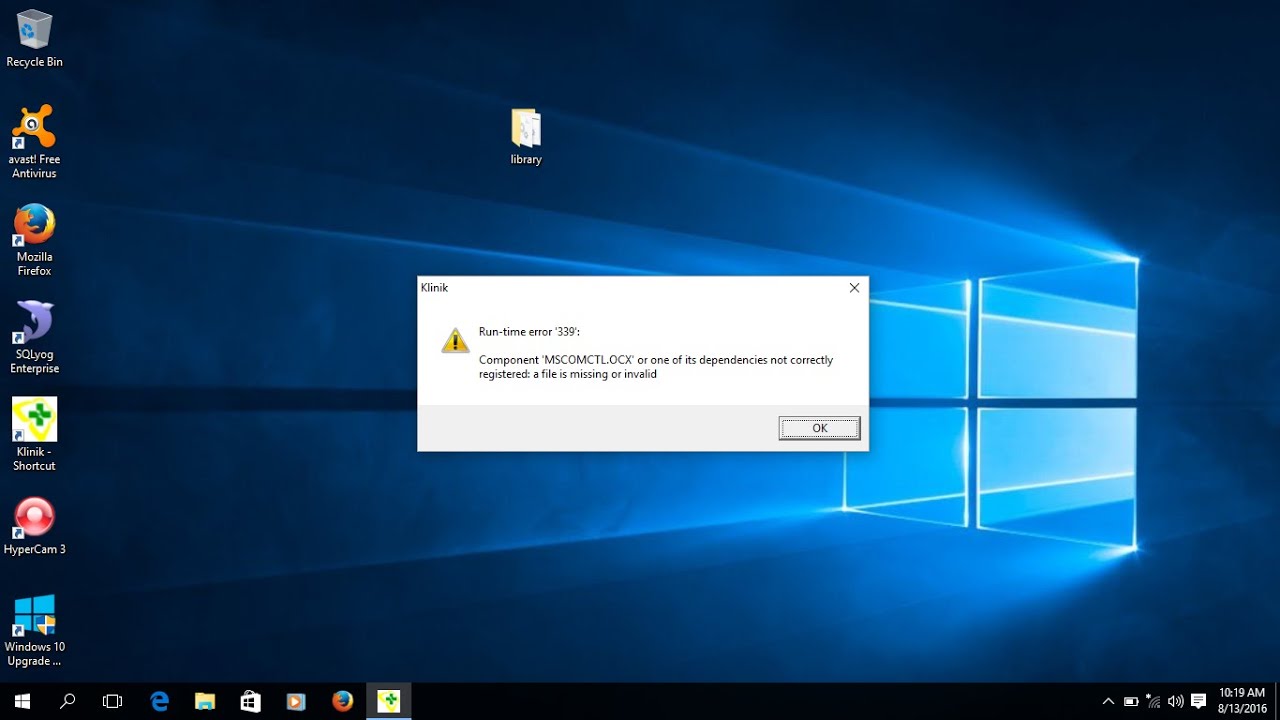
I have had my vb6 programs work on all versions of Windows. I have compiled on XP 32bit, Vista 32bit and now I compile on Windows 8 64bit A few years ago I decided to add some functions that were not available for Windows 2000 but that is not important now since it works on XP, Vista, 7 and 8 (even on starter versions) all of these on 32 or 64 bit variants. There were some cases where initially my programs would not work and here is what I did. 1) For Windows Vista, 7 and 8 you need to Run as Administrator You may need to change advanced properties every time you reinstall. 2) In some cases you also need to install a VB6 Runtime update downloaded from Microsoft?s website 3) Less likely you need to install some dlls and ocxs yourself like MSCOMCTL.OCX That?s all I could remember for now.
I'm sure Rob Crombie will jump in at some point, bemoaning the issue of dependencies of your run-time and creating apps that are independent of other components, but the bottom line is that it happens. (Sorry Rob to spoil your thunder:-) As most people have said, there shouldn't be an issue if you follow the guide lines. Jorgearr's list is pretty good, but you also need to ensure that you: a) use up-to-date database technologies as there are problems with trying to installing legacy DLLs on system that already have a newer version installed. It's the 'I've got a later version already, I'm not going to install that older version' symptom. B) use a 'sensible' installer that understands about dependencies and COTS type OCX dependencies such as ADO drivers etc. Then it's a matter of testing on various clean machines.
Using a virtual machine is good for that. As Rob Lee's implied - is there anything wrong at the moment? Chasing an invisible problem will waste a lot of time.
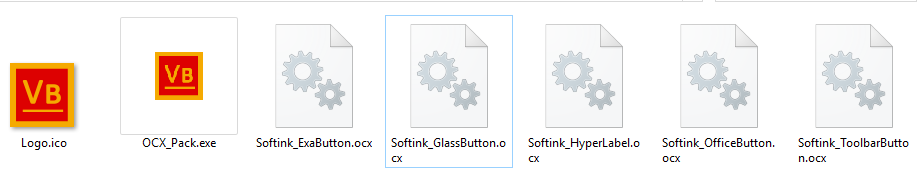
Thanks but someone suggests I use a registrator to register all DLLs and OCXs. So here they are if you or anyone can do it for me, please. Asycfilt.dll b8Controls Codejock.SkinFramework.v15.0.1.ocx COMCAT.DLL ComDlg32.ocx Crpaig80.dll Crystl32.OCX Implode.dll lvButton.ocx mfc42.dll MSBIND.DLL MSCOMCT2.OCX MSCOMCTL.OCX MSDATGRD.OCX MSDATLST.OCX MSDBRPTR.DLL MSDERUN.DLL MSHFLXGD.OCX MSSTDFMT.DLL msvbvm60.dll msvcrt.dll NSStyleButton.ocx olepro32.dll P2smon.dll RICHED32.DLL richtx32.ocx scrrun.dll sscsdk80.dll TabCtl32.ocx VB6STKIT.DLL Thanks once again.
Here is you code for the installer on the destination machine. Hi Sir Dennis, You asked to have these files on my system before registering Crystl32.OCX But I do not have them, so do please kindly send it to me ASAP ADVAPI32.DLL COMCTL32.DLL COMDLG32.DLL CRPE32.DLL GDI32.DLL IMPLODE.DLL MFC42.DLL MSVCRT.DLL MSVCRT20.DLL OLE32.DLL OLEAUT32.DLL OLEDLG.DLL OLEPRO32.DLL USER32.DLL VERSION.DLL My program is developed on Win7, 64bit. Can it be installed on any system such as: WinXP, Win7 or 8 and 32bit and 64bit? Kindly help me ASAP so that I will be able to install the program to my clients.
Thanks a lot. Godwin, The code I gave you is your solution, just copy-paste on a vb6 module and do your changes then compile as installer, put the installer in a folder, put the listed dlls and ocxs in the same folder, copy the folder to your destination machine, double click on xp or right click and run as administrator on 7, 8. It should install your application. Then you can beautify it. One suggestion, you should eliminate unnecessary files until you get them working fine. Probably you don?t need a skin to start with. Also it seems that your problem is related to Crystal Reports installation, which you could install separatelly (with license), before your application.
I am not an expert on Crystal since I mostly use DataReport for being free. I've not used VB6 in anything newer than Vista. While I run Win7 for my primary dev environment, I keep all of the VB6 stuff on a Vista virtual machine, and do all VB6 work in there. That said, there shouldn't be any reason that it won't run as well as it does in Vista or Win7 (pretty poorly in my experience, but.).
Luckily I'm winding down all VB6 development for good (after almost 8 years of converting piece by piece to.NET, while writing all new code in.NET). We'll have the final app converted to.NET by December, and will drop all support for the last VB6 version on April 8th when we drop XP support. Frankly I'll be glad to see both of them go.

Yes, computers have unconditional Jump instructions. And the worst 'spaghetti code' I ever encountered was written in Assembly Language by someone who used Jumps all over the place.
Mscomm32 Ocx Download Windows 10
Refactoring the code (a term that didn't exist for another twenty years) to use subroutines, sequential conditionals (the equivalent of a Select or Switch statement), and state variables was required just to be able to successfully debug the code. One of the more useful rules for using unconditional Jumps was that the destination should always be down the page from the Jump instruction? Unless you had a very good reason to do otherwise.
This was pretty much the equivalent of the high-level language rule that we don't use GoTos unless we really have to. Very early COBOL was filled with GoTo's. Then there was the Alter verb that coders used. I don't know how anyone ever thought of it unless memory restrictions and overlays were the cause. The Alter verb changed the destination of a GoTo.
For example, the code might say Perform ProcessRecords. The ProcessRecords code would then have a GoTo ProcessHeader in it to process a header record the first time through. At the end of the ProcessHeader Subroutine would be the Alter Statement saying Alter ProcessHeader to ProcessDetail followed by the subroutine exit. Note, this was way before structured programming techniques and few subroutines were numbered.
After the Alter line and from that point forward, when ProcessRecords was executed for all subsequent records, the line of code that said 'GoTo ProcessHeader' didn't go to the ProcdessHeader Subroutine. It went to the ProcessDetail Subroutine. 'Course nothing prevented another Alter from changing direction again to add even more confusion. Between the Alter and overlays, early code could be truly difficult to debug when needed. I always worked very hard to remove the Alter every time I found it. Rob, 32 but installer is fine with me, my thought on a 64 bit version of the install is for example if you are targeting Access 2010 64, does that need a different driver that the 32 bit version of Jet? I know in dot net (where I spend the bulk of my time now) there are differences in providers.
I have also noticed that when downloading programs from the Internets these days that you often see 32 bit versions and 64 bit versions. I think much of these issues will disappear in a few years as everything becomes virtualized but that is another subject:-) John Warner.