32 Band Graphic Equalizer Software
What you want to achieve with a 32 band equalizer is to correct frequency response notches in the spectrum. The microphone should be calibrated otherwise the measurements will have no meaning. The idea is to use test tones (can be put on a CD or come from a signal generator) through the amp to the speakers and place the mic at your listening position. Then start with a 1kHz tone and set the amp so that it produces a normal listening SPL (say 85dB).
Consider that your reference level. Then try different frequencies. The mic should measure a different level for each frequency.
Digital Graphic Equalizer
If it measures, say, 83dB at 2kHz, it means that the equalizer should be used to boost 2kHz by 2dB. If it measures 90dB at 250Hz it means that the equalizer should be used to attenuate 250Hz by 5dB. If the equalizer has separate controls for each channel, you can do this measurement and calibration for each channel separately. Especially if your listening space isn't perfectly symetrical - hardly any room is.
You can also utilize a white/pink/brown noise generator and a spectrum analyser (e.g. In that case you see (more or less) the bumps and valleys graphically there and can adjust each frequency accordingly. Expect to find and measure some louder levels in the low frequencies (.
What you want to achieve with a 32 band equalizer is to correct frequency response notches in the spectrum. The microphone should be calibrated otherwise the measurements will have no meaning. The idea is to use test tones (can be put on a CD or come from a signal generator) through the amp to the speakers and place the mic at your listening position. Then start with a 1kHz tone and set the amp so that it produces a normal listening SPL (say 85dB). Consider that your reference level. Then try different frequencies.
The mic should measure a different level for each frequency. If it measures, say, 83dB at 2kHz, it means that the equalizer should be used to boost 2kHz by 2dB. If it measures 90dB at 250Hz it means that the equalizer should be used to attenuate 250Hz by 5dB.
If the equalizer has separate controls for each channel, you can do this measurement and calibration for each channel separately. Especially if your listening space isn't perfectly symetrical - hardly any room is. You can also utilize a white/pink/brown noise generator and a spectrum analyser (e.g. In that case you see (more or less) the bumps and valleys graphically there and can adjust each frequency accordingly. Expect to find and measure some louder levels in the low frequencies (.
If you use a calibrated mic connected to a calibrated measurement system then the readings are directly valid. If you connect the mike to a PC via a mixer (for example) then you have the mixer gain and PC gain to set and worry about. But you don't really need to worry about that. Just select an adequately loud setting on the amp, place the microphone where you would sit and set the gain for the microphone so that you have a good signal (i.e. The test tone is much much louder than the residual system's noise).
Use the 1kHz reading as reference (just name that 0dB) and anything above that would be +db and anything lower than that -dB values. If you use a calibrated mic connected to a calibrated measurement system then the readings are directly valid. If you connect the mike to a PC via a mixer (for example) then you have the mixer gain and PC gain to set and worry about. But you don't really need to worry about that.
Free midi songs for piano. Items 1 - 36 of 7697 - Listen. Title / Artist. Like a Virgin Madonna. Santa Maria Roland Kaiser. Pop, Schlager. Golden Lions Head. All Falls Down Alan Walker featuring. Dance / Electronic, Pop. Something About You Level 42. Dance / Electronic, Disco, Pop. Peaceful Easy Feeling Eagles. Darling Pretty Mark Knopfler. Dancing Queen Jurassic Park 1492 Conquest of Paradise The Good, the Bad and the Ugly Five Nights at Freddy's 2 Song (It's Been so long) James Bond someone like you Pokemon Rock with You Mickey Mouse Club When You Wish Upon A Star Pirates Of The Caribbean Jingle Bells New York, New York. Explore the New Yamaha MusicSoft Website! Take a tour of some of the navigational features on our new Yamaha MusicSoft website. Visit The Blog. MIDI & Styles Tiered. Save on MIDI Songs & Style Files! Buy More, Save More.
Just select an adequately loud setting on the amp, place the microphone where you would sit and set the gain for the microphone so that you have a good signal (i.e. The test tone is much much louder than the residual system's noise). Use the 1kHz reading as reference (just name that 0dB) and anything above that would be +db and anything lower than that -dB values. Click to expand.OK, I am not sure what this sw does and how it works but; If the display only shows a dB range from 0dB down to -80dB, then I would set amp level so that I get -10dB at 1kHz. That leaves some headroom (10dB) for bumps and plenty of room for valleys. Now, regarding the sw at hand, I am suspecting that the PC running it is both the source and receiver of tones. I am suspecting that it generates tones at various frequencies, you feed these through the amp to the speakers, grab the sound with the mike that you connect to the PC's Line In.
If I am guessing right, the equalizer in the sw allows you to set gain at different frequencies so that the bars show equal levels at all frequencies. You then 'copy' the settings to a real equalizer to use with your system. Or something like that. OK, I am not sure what this sw does and how it works but; If the display only shows a dB range from 0dB down to -80dB, then I would set amp level so that I get -10dB at 1kHz. That leaves some headroom (10dB) for bumps and plenty of room for valleys.
Now, regarding the sw at hand, I am suspecting that the PC running it is both the source and receiver of tones. I am suspecting that it generates tones at various frequencies, you feed these through the amp to the speakers, grab the sound with the mike that you connect to the PC's Line In.
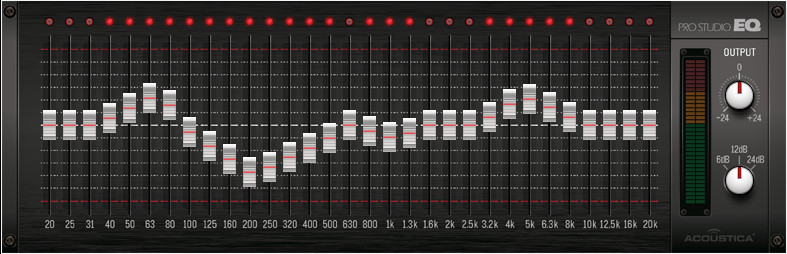
If I am guessing right, the equalizer in the sw allows you to set gain at different frequencies so that the bars show equal levels at all frequencies. You then 'copy' the settings to a real equalizer to use with your system.
32 Band Graphic Equalizer Software
Or something like that.