Object Oriented Software Engineering Ivar Jacobson Ebook
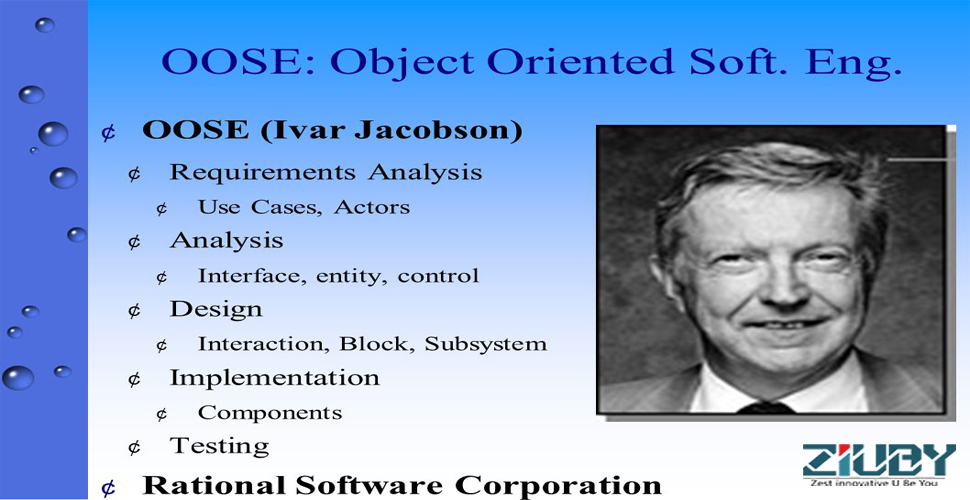
Ivar Jacobson,Vice President of Business Engineering, is the inventor of the OOSE method, and he is also the founder of Objectory AB in Sweden, which recently merged with. Jacobson is the principal author of two influential and best-selling books: Object-Oriented Software Engineering—A Use Case Driven Approach (Computer Language Productivity award winner in 1992) and The Object Advantage—Business Process Reengineering with Object Technology.
He has also authored several widely referenced papers on object technology. One of the most famous papers is his first OOPSLA '87 paper entitled 'Object-Oriented Development in an Industrial Environment,' which presented the first truly object-oriented method ever published. Ivar Jacobson's use-case driven approach has had a very strong impact on the entire OOAD industry, and he himself has become one of its 'icons.' Consequently, he is a frequently invited keynote speaker and panelist, debating OOAD topics with colleagues and methodologists such as Grady Booch, Jim Rumbaugh, Steven Mellor, and Rebecca Wirfs-Brock at major OO conferences around the world. He is well known for his pioneering work and more than 20 years of experience in using object methods for the design of large real-time systems. His early object-based design technique has evolved into the international standard ITU (formerly CCITT)/SDL.
Jacobson also regularly serves on the OOPSLA, ECOOP, and TOOLS program committees, and he is a member of the advisory board of the Journal of Object-Oriented Programming. In 1994, Ivar Jacobson received the first Swedish Computer Association (SCA) award (the Kjell Hultman prize) for 'extraordinary achievement in promoting efficiency and productivity in the development and use of information technology.'
Object Oriented Software Engineering
Table of Contents Part 1. Introduction 1.
System development as an industrial process Introduction A useful analogy System development characteristics Summary 2. The system life cycle Introduction System development as a process of change System development and reuse System development and methodology Objectory Summary 3. What is object-orientation?
Introduction Object Class andinstance Polymorphism Inheritance Summary 4. Object-oriented system development Introduction Function/data methods Object-oriented analysis Object-oriented construction Object-oriented testing Summary 5. Object-oriented programming Introduction Objects Classes and instances Inheritance Polymorphism An example Summary Part II. Architecture Introduction System development is model building Model architecture Requirements model Analysis model The design model The implementation model Test model Summary 7. Analysis Introduction The requirements model The analysis model Summary 8.
Construction Introduction The design model Block design Working with construction Summary 9. Real-time specialization Introduction Classification of real-time systems Fundamental issues Analysis Construction Testing and verification Summary 10. Database Specialization Introduction Relational DBMS Object DBMS Discussion Summary 11. Components Introduction What is a component? Use of components Component management Summary 12.
Testing Introduction On testing Unit testing Integration testing System testing The testing process Summary Part III. Applications 13. Case study: warehouse management system Introduction to the examples ACME Warehouse Management Inc. The requirements model The analysis model Construction 14. Case study: telecom Introduction Telecommunication switching systems The requirements model The analysis model The design model The implementation model 15. Managing object-oriented software engineering Introduction Project selection and preparation Project development organization Project organization and management Project staffing Software quality assurance Software metrics Summary 16. Other object-oriented methods Introduction A summary of object-oriented methods Object-Oriented Analysis (OOAD/Coad-Yourdon) Object-Oriented Design (OOD/Booch) Hierarchical Object-Oriented Design (HOOD) Object Modeling Technique (OMT) Responsibility-Driven Design Summary Appendix A On the development of Objectory Introduction Objectory as an activity From idea to reality References Index.
About the Author(s) Dr. Ivar Jacobson,Vice President of Business Engineering, is the inventor of the OOSE method, and he is also the founder of Objectory AB in Sweden, which recently merged with.
Jacobson is the principal author of two influential and best-selling books Object-Oriented Software Engineering-A Use Case Driven Approach (Computer Language Productivity award winner in 1992) and The Object Advantage-Business Process Reengineering with Object Technology. He has also authored several widely referenced papers on object technology. One of the most famous papers is his first OOPSLA '87 paper entitled 'Object-Oriented Development in an Industrial Environment,' which presented the first truly object-oriented method ever published. Ivar Jacobson's use-case driven approachhas had a very strong impact on the entireOOAD industry, and he himself has become one of its 'icons.'
Consequently, he isa frequently invited keynote speaker and panelist, debating OOAD topics withcolleagues and methodologists such as Grady Booch, Jim Rumbaugh, StevenMellor, and Rebecca Wirfs-Brock at major OO conferences around the world. He is well known for his pioneering work and more than 20 years of experience inusing object methods for the design of large real-time systems. His earlyobject-based design technique has evolved into the international standardITU(formerly CCITT)/SDL.
Jacobson also regularly serves on the OOPSLA, ECOOP, and TOOLSprogram committees, and he is a member of the advisory board of the Journal ofObject-Oriented Programming. In 1994, Ivar Jacobson received the first Swedish Computer Association (SCA)award (the Kjell Hultman prize) for 'extraordinary achievement in promotingefficiency and productivity in the development and use of informationtechnology.'
Patrik Jonsson works at Rational Software Corporation in Sweden as a Senior Consultant where he has been developing the architecture and method of the Objectory process with a current focus on reuse and user interface development. Reviews 'In this book Jacobson establishes a new direction for the future of software engineering practice. It is a thorough presentation of ideas and techniques that are both solidly proven and simultaneously at the leading edge of software engineering methodology.'
Constantine, RODP, Organization & System Consultant 'Object-Oriented Software Engineering belongs in the book collection of every serious student of object methodologies.' Larry O'Brien, Editor, COMPUTER LANGUAGE 'Perhaps the most profound and deeply revealing volume on object technology to date. It is simply a must-own book.' Steve Bilow, Journal of Object-Oriented Programming 'Jacobson is in my opinion one of the foremost methodologists in the field of Software Engineering. I strongly recommend. Not only for software managers and designers but for anyone who wishes to understand how the next generation of Software Systems should be built.'
Dave Thomas, Object Technology International. Backcover Copy How can software developers, programmers and managers meet the challenges of the 90s and begin to resolve the software crisis?This book is based on Objectory which is the first commercially available comprehensive object-oriented process for developing large-scale industrial systems. Ivar Jacobson developed Objectory as a result of 20 years of experience building real software-based products. The approach takes a global view of system development and focuses on minimizing the system's life cycle cost. Objectory is an extensible industrial process that provides a method for building large industrial systems. This revised printing has been completely updated to make it as accessible and complete as possible.
New material includes the revised Testing chapter, in which new product developments are discussed. Reviews 'In this book Jacobson establishes a new direction for the future of software engineering practice. It is a thorough presentation of ideas and techniques that are both solidly proven and simultaneously at the leading edge of software engineering methodology.' Constantine, RODP, Organization & System Consultant 'Object-Oriented Software Engineering belongs in the book collection of every serious student of object methodologies.'
Larry O'Brien, Editor, COMPUTER LANGUAGE 'Perhaps the most profound and deeply revealing volume on object technology to date. It is simply a must-own book.' Steve Bilow, Journal of Object-Oriented Programming 'Jacobson is in my opinion one of the foremost methodologists in the field of Software Engineering. I strongly recommend. Not only for software managers and designers but for anyone who wishes to understand how the next generation of Software Systems should be built.' Dave Thomas, Object Technology International B04062001.
Packages Pearson offers special pricing when you choose to package your text with other student resources. If you're interested in creating a cost-saving package for your students, browse our available packages below, or contact your to create your own package. Package ISBN-10: ISBN-13: 189 ©1992.
Out of Print This package contains:. Jacobson ISBN-10:. ISBN-13: 350 ©1992. Paper, 552 pp. Jacobson, Griss & Jonsson ISBN-10:.
ISBN-13: 763 ©1997. Paper, 528 pp. Pearson Learning Solutions Nobody is smarter than you when it comes to reaching your students. You know how to convey knowledge in a way that is relevant and relatable to your class. It's the reason you always get the best out of them. And when it comes to planning your curriculum, you know which course materials express the information in the way that’s most consistent with your teaching. That’s why we give you the option to personalise your course material using just the Pearson content you select.
Object Oriented Software Engineering Ivar Jacobson Ebook Login
Take only the most applicable parts of your favourite materials and combine them in any order you want. You can even integrate your own material if you wish. It's fast, it's easy and fewer course materials help minimise costs for your students. For more information: “Creating a personalised resource was a constructive and positive course development for me, as everything is now integrated, aligned and consistent.” — John Sanders, School of Management and Languages, Heriot-Watt University, UK'. Personalised Content Solutions Explore our range of textbook content across the disciplines and see how you can create your own textbook or eBook.
Custom textbooks and eBooks Pick and choose content from one or more texts plus carefully-selected third-party content, and combine it into a bespoke book, unique to your course. You can also include skills content, your own material and brand it to your course and your institution. Read about Durham University's experience of creating a bespoke course eBook for their engineering students. Personalised Digital Solutions Pearson Learning Solutions will partner with you to create a completely bespoke technology solution to your course's specific requirements and needs. Develop websites just for your course, acting as a bespoke 'one-stop shop' for you and your students to access eBooks, MyLab or Mastering courses, videos and your own original material.
Include highly engaging bespoke games, animations and simulations to aid students' understanding, promote active learning and accommodate their differing learning styles. Customise existing Pearson eLearning content to match the specific needs of your course. Simply share your course goals with our world-class experts, and they will offer you a selection of outstanding, up-to-the-minute solutions.
For more information.